
Showing posts with label CAJS. Show all posts
Showing posts with label CAJS. Show all posts
Monday, November 12, 2012
Right to health
Right to health and humans rights implies opportunities and challenges to health systems. saluderecho.net is a space to interchange information and ideas.

Wednesday, October 26, 2011
Joint Annual Technical Meeting of the American Legal Social Commission (CAJS) and Sub-Region V: Mexico and the Latin Caribbean, in Havana, Cuba.
On Thursday 20 and Friday October 21, in the Taganana Meeting Room of the historical National Hotel in the Habana, Cuba, took place the Joint Technical Meeting of the CAJS and Sub-Region V, with the main thematic of the "Transformation of Labor Legislation and Social Protection in Ages Close to Retirement", thanks to the kind support of Cuba’s Ministry of Labor and Social Security.
The meeting consisted of five technical conferences on retirement issues and a sub-regional panel which was attended by representatives of different countries, who spoke on the legal reforms of the retirement age. The speakers who participated were Dr. Gabriel Martínez, Secretary General of the CISS; Ms. Bárbara López, Legal Director of Cuba’s National Social Security Institute; Mr. Walter Funes of the Salvadoran Social Security Institute; Dr. Rafael Modesto Pérez, General Manager of the National Council for Social Security of the Dominican Republic; Dr. Jorge D'Angelo, President of the American Commission for Older Adults; Dr. Estela Altalef, Academic of AMAOTE; Dr. Alberto Fernandez, Director of Care for the Elderly of the Ministry of Public Health of Cuba; Dr. Victor Hugo Borja, Head of the Coordination of Epidemiological Surveillance from the Mexican Institute of Social Security (IMSS), Eduardo Morales Aguirre, Coordinator of Social Benefits IMSS; Dr. Martha Miranda, Researcher of the CISS; Verónica Zetter, Coordinator of Institutional Risk Management of IMSS, and Dr. Fidel Ferreras, Social Security Consultant and Former Director of the National Social Security Institute of Spain. As part of the presidium of the meeting, we counted on the distinguished participation of Ms. Yusimí Campos, Cuba’s National Director of Social Security; Mr. Josue Argeñal of Hondura’s Social Security Institute for Law Professionals, and Technical Secretary of the CAJS; Mr. Iker Reyes, Deputy Director of International Affairs at the Institute of Security and Social Services for State Workers, Mexico (ISSSTE), and Dr. Martínez.
One of the most important aspects of this meeting was the presentation of The Americas Social Security Report 2012 by the CISS, and in particular the results of the analysis of social security systems’ expected benefits for retirement in Latin America and the Caribbean.
In total, the meeting was attended by 45 officers from twelve social security institutions and 9 countries from Europe, Latin America and the Caribbean.
In the following days, you will be able to find all the material of the event (presentations, pictures and list of attendants) directly at the CISS webpage: www.ciss.org.mx
The meeting consisted of five technical conferences on retirement issues and a sub-regional panel which was attended by representatives of different countries, who spoke on the legal reforms of the retirement age. The speakers who participated were Dr. Gabriel Martínez, Secretary General of the CISS; Ms. Bárbara López, Legal Director of Cuba’s National Social Security Institute; Mr. Walter Funes of the Salvadoran Social Security Institute; Dr. Rafael Modesto Pérez, General Manager of the National Council for Social Security of the Dominican Republic; Dr. Jorge D'Angelo, President of the American Commission for Older Adults; Dr. Estela Altalef, Academic of AMAOTE; Dr. Alberto Fernandez, Director of Care for the Elderly of the Ministry of Public Health of Cuba; Dr. Victor Hugo Borja, Head of the Coordination of Epidemiological Surveillance from the Mexican Institute of Social Security (IMSS), Eduardo Morales Aguirre, Coordinator of Social Benefits IMSS; Dr. Martha Miranda, Researcher of the CISS; Verónica Zetter, Coordinator of Institutional Risk Management of IMSS, and Dr. Fidel Ferreras, Social Security Consultant and Former Director of the National Social Security Institute of Spain. As part of the presidium of the meeting, we counted on the distinguished participation of Ms. Yusimí Campos, Cuba’s National Director of Social Security; Mr. Josue Argeñal of Hondura’s Social Security Institute for Law Professionals, and Technical Secretary of the CAJS; Mr. Iker Reyes, Deputy Director of International Affairs at the Institute of Security and Social Services for State Workers, Mexico (ISSSTE), and Dr. Martínez.
One of the most important aspects of this meeting was the presentation of The Americas Social Security Report 2012 by the CISS, and in particular the results of the analysis of social security systems’ expected benefits for retirement in Latin America and the Caribbean.
In total, the meeting was attended by 45 officers from twelve social security institutions and 9 countries from Europe, Latin America and the Caribbean.
In the following days, you will be able to find all the material of the event (presentations, pictures and list of attendants) directly at the CISS webpage: www.ciss.org.mx
Tuesday, August 30, 2011
Gender equality: the child bonus
A challenge for pension systems is to achieve gender equity. It is common that in a couple, the man works while the woman stays at home to have children and care for them. Entitlement to a pension is usually related to work experience. A compensating mechanism is the bonus per child in Chile. This is an amount received by the woman through her individual retirement account and is used to increase the value of her pension; it can not be withdrawn as a lump sum, but can be used to improve the value of a pension after age 65
Tuesday, August 23, 2011
Monday, June 21, 2010
Chilean health insurance: growth of supplementary plans
Chile keeps a segmented regulation to health insurance. On one side, the financial authority regulates part of the market, while the Health Superintendent regulates the ISAPRE plan. This article lists some of the issues that arise from this dichotomy.
Friday, June 11, 2010
Labor reform in Spain
In Spain, the negotiations on labor reform ran until dawn of Friday June 11. The direct motivation is to pass a reform that would be seen as a signal of confidence in the government, that in turn would expect to ease its way into a negotition to finance the fiscal deficit. As happens during crises, emergency solutions are rarely the best and they leave scars. Why are governments--executive and legislative--sometimes unable to correct evident problems is a key question in political economy. Regardless of the political preference, with long-term unemployment rates above 10%, and reaching sometimes 20%, with low levels of effort and hours worked, with persistent lags in productivity, nobody believed that the Spanish labor market was well-functioning. A useful reference is the Proposal for the labor reactivation of Spain, available in English, launched in April 2009 by a group of Spanish economists. There are some of the leaders in the profession: Abadie, Mas Collel, Amuedo, Barberá and several more.
Thursday, April 29, 2010
Migration from Spain to the Americas

The figures on migration from Spain to the Americas show some "surprises".
- The South Cone is the definite destination of the Spanish today (nearly half a million).
- Mexico, Canada and the US have really low numbers (around 150 thousand).
- Venezuela is an attractive destination for the Spanish, with 167 thousand.
Tuesday, April 27, 2010
Central American free-trade and labor issues

The Central American Integration Bank, through the office of Pablo Rodas, organized a meeting on the impact of free trade in the region. One of the speakers was Virgilio Levaggi, of the ILO, who talked about the process of the White Book agreed among the countries to evaluate labor issues. Yolanda Mayora de Gavidia, the Secretary for Central American Economic Integration also gave a very interesting talk. As we see in the table, CA has diversified noticeably towards China and Asia in general, South America, the Caribbean and the Andean Region. Now, manufacturing is the main export, leaving behind bananas, coffee and sugar. Certainly, the effect on labor markets are being felt.
Friday, April 16, 2010
Labour reform in Spain
Spain is likely to take an individual account system to control the moral hazard problem in unemployment insurance ...
Tuesday, November 3, 2009
From the CISS annual meeting in Guatemala (second report)
In his intervention Lucio Santos from the Ministry of Social Protection in Brazil highlighted what the country has done to face the current global recession. Here the main actions: i) the minimum wage was increased (now is set at 260USD), which increased the incomes of social security beneficiaries; ii) the benefits of the unemployment insurance were extended and; iii) some efforts to extend coverage were put in place, such as the program MEI (individual microentrepreneur), which provides social security benefits to this group and charges 11% of the minimun wage as contribution, and the program to afíliate house workers (in exchange of a contribution which can be deducted from income taxes). As a consequence, the executive secretary adjoint Santos explained that while 800,000 jobs were destroyed during the last months of 2008 and first of 2009, now job creation reaches 1,000,000 employees.
Wednesday, March 11, 2009
OAS workshop on migration
The Department of Social Development and Employment of the OAS has published the summary of the workshop on migration. It took place in Quebec a few weeks ago. The link is:
http://www.sedi.oas.org/ddse/english/cpo_trab_quebec.asp
http://www.sedi.oas.org/ddse/english/cpo_trab_quebec.asp
Monday, February 23, 2009
The most important social security institutions in Mexico signed a portability agreement
Last week, IMSS and ISSSTE, the social security institutions for the workers of the private and public sector in Mexico respectively, signed a portability agreement. The agreement establishes that workers´ contributions to both schemes will be recognized in the calculation of minimum requirements to get benefits and in the amount of benefits. The agreement contemplates old age pensions, medical services and other social benefits. The agreement could be reached after the reform to the ISSSTE scheme that took place in 2007. We have analyzed the social security international agreements at the CISS in our Annual Report of 2006.
Thursday, February 5, 2009
Unemployment and Social Security
The world economy has increasingly felt the effects of the crisis. Governments have acknowledged the problems, and have recognized that unemployment is the most risky consequence of the downturn. While governments are taking measures to address the economic problems it is necessary to evaluate what can be done to protect the well being of their populations through the development and management improvement of unemployment programs. The CISS has dealt with these two topics in its annual reports.
The 2007 Annual Report on Social Security in the Americas weighed the phenomenon of globalization, the main debates around it, the form in which international trade negotiations have evolved, and the degree to which they affect social protection. This is an important issue for social security institutions, as these changes may affect households’ well-being. One of the greatest concerns of countries is the possibility that large groups of people might lose their jobs due to the globalization process, especially when unemployment becomes a long-term problem. Chapter V of the report analyzes the development of unemployment programs as tools of social security to protect the population.
The 2008 Annual Report on Social Security in the Americas provides the best practices in the processes management of social programs. Chapter VIII of the report analyzes the processes of the unemployment insurance and the way in which these processes can be improved to guarantee that unemployment benefits programs are optimally delivered.
The 2007 Annual Report on Social Security in the Americas weighed the phenomenon of globalization, the main debates around it, the form in which international trade negotiations have evolved, and the degree to which they affect social protection. This is an important issue for social security institutions, as these changes may affect households’ well-being. One of the greatest concerns of countries is the possibility that large groups of people might lose their jobs due to the globalization process, especially when unemployment becomes a long-term problem. Chapter V of the report analyzes the development of unemployment programs as tools of social security to protect the population.
The 2008 Annual Report on Social Security in the Americas provides the best practices in the processes management of social programs. Chapter VIII of the report analyzes the processes of the unemployment insurance and the way in which these processes can be improved to guarantee that unemployment benefits programs are optimally delivered.
Tuesday, January 6, 2009
Retirement patterns
Population ageing and financial cost for social security systems has lead to changes in retirement rules in systems around the world. To give incentives for late retirement, systems has changed from defined benefits to defined contributions systems (in reformed countries), mortality tables have been taken into account when setting the benefits (Brazil) and minimum age of retirement have been raised. In this regard it is worth mentioning that raising minimum age of retirement can have little effect if implicit rules fail to generate incentives for people to delay retirement. Gruber and Wise, among others, have carefully analyzed this phenomenon for European countries. As an example, in the Mexican IMSS system, the legal retirement age is 65 but workers can retire at 60 with a cost of 3% of their pension by each year of retirement before 65. Mexican economist Emma Aguila has shown that this cost for early retirement does not generate the incentives for workers to delay retirement. In fact, as can be seen in the next figure, most people at IMSS retire at 60 years old.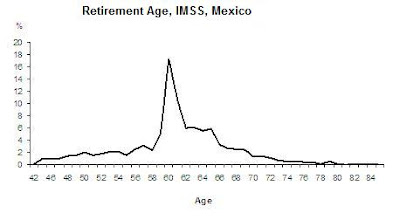

Tuesday, December 16, 2008
Information, decisions and social security
Social security systems that give an important role to the markets, in health and in pensions, are built on the assumption that persons can take rational decisions. We believe people can take rational choices given that they are not information constrained. Nevertheless, there are several examples in health and pensions in which the acquisition of information is very costly. For example, in the United States many people covered through Medicare's Part D drug-insurance program find very difficult to calculate their cost of drugs, specially in the system known as reference-based pricing (patients who opt for a brand name drug when a generic equivalent is available must pay a copayment and the difference in prices). In the case of reformed pension schemes, specialist had agreed that the low competition observed in the markets is mostly explained by the low elasticity of the demand and to a lesser extend by supply factors: potential affiliates choose their pension fund manager based on promotional efforts rather than on fees and returns, key elements that will determine the pension.
This behavior must be taken into account for the design of social security programs. In this regard, we believe that
1. Policy makers should be aware that systems take time to mature. At the initial years of the program people can make mistakes in their decision but as the system matures people start making more rational decisions, this is the experience in reformed pension schemes.
2. Policy makers should simplify the decision that an affiliate should take. It has been widely proved that when persons are confronted to easier decisions they make more rational choices.
3. Authorities should implement important informational campaigns. In this regard, public agencies have an important role to educate affiliates. Information should take place at two levels, mass and personal based.
This behavior must be taken into account for the design of social security programs. In this regard, we believe that
1. Policy makers should be aware that systems take time to mature. At the initial years of the program people can make mistakes in their decision but as the system matures people start making more rational decisions, this is the experience in reformed pension schemes.
2. Policy makers should simplify the decision that an affiliate should take. It has been widely proved that when persons are confronted to easier decisions they make more rational choices.
3. Authorities should implement important informational campaigns. In this regard, public agencies have an important role to educate affiliates. Information should take place at two levels, mass and personal based.
Thursday, December 11, 2008
Global crisis: potential permanent effects of the crisis
As we have mentioned in previous notes, the global crisis will have an important impact on employment and salaries. The effect on one or the other depends on the labor supply elasticity and rigidities of wages. Economist in LAC have tried to measure the labor supply elasticity in economies with an important informal market and have tried to assess the impact of some rules, minimum wage for example, on the rigidity of wages. There are other important questions regarding the impact of a crisis in the labor markets, for example, what happen to people after displacement?
In an article, Gabriel Martínez, CISS´s General Secretary, and other co-authors found that after the Mexican crisis of 1995: i) some people could find another formal job, in many cases at a lower wage; ii) more people could find a job in economically active regions, that in the case of Mexico in those years were the border region; and iii) some people who lost their formal job were unable to find a new one (formal). This last effect was particular important for persons over 40 years old at the moment of the crisis.
Although the current crisis is different from the Mexican crisis in 1995 -- today involves almost all countries, these findings can be used to design social protection policies to the most vulnerable groups in order to avoid a permanent effect of the crisis.
In an article, Gabriel Martínez, CISS´s General Secretary, and other co-authors found that after the Mexican crisis of 1995: i) some people could find another formal job, in many cases at a lower wage; ii) more people could find a job in economically active regions, that in the case of Mexico in those years were the border region; and iii) some people who lost their formal job were unable to find a new one (formal). This last effect was particular important for persons over 40 years old at the moment of the crisis.
Although the current crisis is different from the Mexican crisis in 1995 -- today involves almost all countries, these findings can be used to design social protection policies to the most vulnerable groups in order to avoid a permanent effect of the crisis.
Tuesday, December 9, 2008
On non contributive programs
The lack of coverage of social security based programs has spurred the implementation of non contributive programs in pensions and health almost all around the continent. While these programs can have a positive impact on the well being of the population, we must be aware of some hurdles that need to be overcome in order to avoid undesirable results given the incentives they provide and the failures in their designs. It has been recognized that no contributive programs:
1) Can have adverse effects in the decision of workers to participate in the formal labor markets and on the entrepreneurs´ decisions regarding their activities.
2) They can have effects in the basket of consumption and savings within families and in the intra-families transfers.
The first means that persons will find more profitable to work in an informal job (that it is not taxed) since at the end the persons will receive the services; and the entrepreneurs will find more profitable also to focus on low productivity (not taxed) activities. The second one refers to the fact that since families will receive extra money they may change their consumption and their savings patterns and intra-family transfers of money.
In order to avoid these distortions, authorities have two main degrees of freedom: size of package to be covered and targeting. This design may help to minimize these adverse effects, still many operational issues should be tackled in order to reach the goals of the program. Moreover a continuous monitoring of the programs is a must.
The following example illustrates (see photo) the alternatives governments have and how programs can fail to reach their goals. The local government of Mexico City offers a non contribute pension to all people over 70 years resident in the city. The pension is equivalent to half of the minimum wage. The pension was aimed at helping elderly during their last years. What we see in the photo is that the pension can be used to pay in a cafeteria in which the average price of a meal equals approximately 1.5 daily minimum wages. This takes us to the following questions: ¿should a pension be provided to all or only to the poor? ¿How can the government guarantee that the money is used to consume basics? ¿How can a more restrictive program be implemented with out increasing significantly the administrative cost?, just to mention a few ones. The answers to these questions should be technical and a monitoring and evaluation strategy can help to design better programs.

Monday, December 8, 2008
Well-being and Social Policy
Well-being and Social Policy is a new peer-reviewed academic publication that is jointly coordinated by the CISS/UNDP/UIA. It is widely distributed in the American Continent among policy decision-makers and researches, and is published in both, English and Spanish, listed in journal indexes. The journal is directed towards academics, students, and decision-makers of the public sector who are not necessarily specialists in the field. For more information on the journal and its content, click here.
Here are a summary of the works published in the journal’s latest issue.
Economic Polarization and Governability in Mexico.
Rodolfo de la Torre
In this work the author intends to appraise alternative hypothesis about the origins of recent social revolt in Mexico. He shows that it is not clear that a severe rise in poverty preceded the origins of violent conflict but social polarization. Therefore, government attempts to deactivate the economic factors that lead to social unrest did not necessarily upgrade poverty-reduction policies.
Is Age-Grade Distortion in Brazil’s Primary Public Education System More Closely Associated to School Infrastructure or to Family Characteristics?
Rosangela Maria Pontili and Ana Lúcia Kassouf
This paper suggests an assessment of the impact that school infrastructure and family characteristics have on age-grade distortions in primary education in Brazil. Interaction between family characteristics and school infrastructure variables were explored to determine the most effective ways to retain students and ensure student promotions. Simulations were also made to assess the impact of enhancing school quality versus improving the socioeconomic status of families on lagging students. Results showed that Sao Paulo students from families headed by less educated heads of households and/or low income families would benefit more from public policies oriented towards improving school infrastructure.
Scale Economies in the Pension Fund Managers Industry in Mexico: A Semi Parametric Approach.
Nelly Aguilera and César Velázquez
In this paper the authors argue that previous studies that have found economies of scale in the case of Mexico were based on cost curves that were empirically not well specified. Authors estimate a semi parametric cost curve which allows them to conclude that if there exists economies of scale, minimum efficient scales are low, being reached by almost all PFM.
Retirement Incentives: Pension Wealth, Accrual and Implicit Tax.
Bernardo Lanza Queiroz
In this work the author estimates social security financial incentives for early retirement using contemporary techniques developed in economics and compares these estimates to those estimated for developed countries. He finds that implicit tax on continued work increases with age and amounts to over one-third of an individual potential earnings at age sixty-five.
Here are a summary of the works published in the journal’s latest issue.
Economic Polarization and Governability in Mexico.
Rodolfo de la Torre
In this work the author intends to appraise alternative hypothesis about the origins of recent social revolt in Mexico. He shows that it is not clear that a severe rise in poverty preceded the origins of violent conflict but social polarization. Therefore, government attempts to deactivate the economic factors that lead to social unrest did not necessarily upgrade poverty-reduction policies.
Is Age-Grade Distortion in Brazil’s Primary Public Education System More Closely Associated to School Infrastructure or to Family Characteristics?
Rosangela Maria Pontili and Ana Lúcia Kassouf
This paper suggests an assessment of the impact that school infrastructure and family characteristics have on age-grade distortions in primary education in Brazil. Interaction between family characteristics and school infrastructure variables were explored to determine the most effective ways to retain students and ensure student promotions. Simulations were also made to assess the impact of enhancing school quality versus improving the socioeconomic status of families on lagging students. Results showed that Sao Paulo students from families headed by less educated heads of households and/or low income families would benefit more from public policies oriented towards improving school infrastructure.
Scale Economies in the Pension Fund Managers Industry in Mexico: A Semi Parametric Approach.
Nelly Aguilera and César Velázquez
In this paper the authors argue that previous studies that have found economies of scale in the case of Mexico were based on cost curves that were empirically not well specified. Authors estimate a semi parametric cost curve which allows them to conclude that if there exists economies of scale, minimum efficient scales are low, being reached by almost all PFM.
Retirement Incentives: Pension Wealth, Accrual and Implicit Tax.
Bernardo Lanza Queiroz
In this work the author estimates social security financial incentives for early retirement using contemporary techniques developed in economics and compares these estimates to those estimated for developed countries. He finds that implicit tax on continued work increases with age and amounts to over one-third of an individual potential earnings at age sixty-five.
Friday, November 28, 2008
Details of the Argentinean Pension Reform
Last November 20th the senate from Argentina approved a new law that created the Integrated Previsional System. The new defined benefit system will take over the private pension account based system. Here are some details of the reform:
- All money of the individual accounts will be administrated by ANSES.
- Money will be used only to pay pensions and will be invested only in Argentina.
- Every worker has the option to transfer the balance in their voluntary account to ANSES, in order to increase his pension; or to a new kind of pension found which, on these cases, will substitute the old pension fund managers (AFJP).
- Periods of contribution in capitalization system will be recognized by ANSES;
- Retired people, who receive their pension from an insurance company, will continue with the same system, but pensioners who received their benefits in a programmed withdrawals scheme, now will be beneficiaries of the public system and ANSES will pay their pensions.
Tuesday, November 25, 2008
The Americas Social Security Report 2009
At the CISS we are convinced that some of the most important problems that beset national social security systems will be solved only after a proper focus is given to administrative and organizational issues. Moreover, we believe that in order to improve, any strategy or reform should be subject to evaluation. The Americas Social Security Report 2009 issued by the CISS and recently released in our Annual Assembly presents what we consider the most applicable approaches to the evaluation of social security programs. The key ideas --that are further developed in the Report for pensions, health, child and long term care-- are:
1. The evaluation should respond to the concerns of different perspectives including the economic, actuarial, administrative, fiscal and operation research.
2. The approach should be carefully designed, and all steps needed for the evaluation should be performed: from the identification of stakeholders to the definition of the strategy to disclose results.
3. Evaluation should be performed for systems, agencies and programs. We consider programs to be managed by agencies and systems to be the collection of agencies and programs. Moreover, we insist that it should be recognized that many processes are performed in an agency and that the system of evaluation should be developed accordingly. To read about administrative models of social insurance we invite you to access the The Americas Social Security Report 2008.
4. Evaluation should have as its object of analysis the citizen. Therefore, the use of micro-data should be the norm and all contacts of the individual with the agencies and programs should be recorded in an integrated way.
We invite those interested in this topic to read our annual Report available at www.ciss.org.mx and to attend our conference “Making Impact Evaluations of Social Program Work” to be held February 12 -13, 2009.
1. The evaluation should respond to the concerns of different perspectives including the economic, actuarial, administrative, fiscal and operation research.
2. The approach should be carefully designed, and all steps needed for the evaluation should be performed: from the identification of stakeholders to the definition of the strategy to disclose results.
3. Evaluation should be performed for systems, agencies and programs. We consider programs to be managed by agencies and systems to be the collection of agencies and programs. Moreover, we insist that it should be recognized that many processes are performed in an agency and that the system of evaluation should be developed accordingly. To read about administrative models of social insurance we invite you to access the The Americas Social Security Report 2008.
4. Evaluation should have as its object of analysis the citizen. Therefore, the use of micro-data should be the norm and all contacts of the individual with the agencies and programs should be recorded in an integrated way.
We invite those interested in this topic to read our annual Report available at www.ciss.org.mx and to attend our conference “Making Impact Evaluations of Social Program Work” to be held February 12 -13, 2009.
Subscribe to:
Posts (Atom)